Research
AI solves an 80-year-old math puzzle. OpenAI calls it a breakthrough
An internal OpenAI model solved a famous Erdős puzzle it was not set up to tackle. The story is less about math and more about whether AI can invent new paths instead of replaying training data.
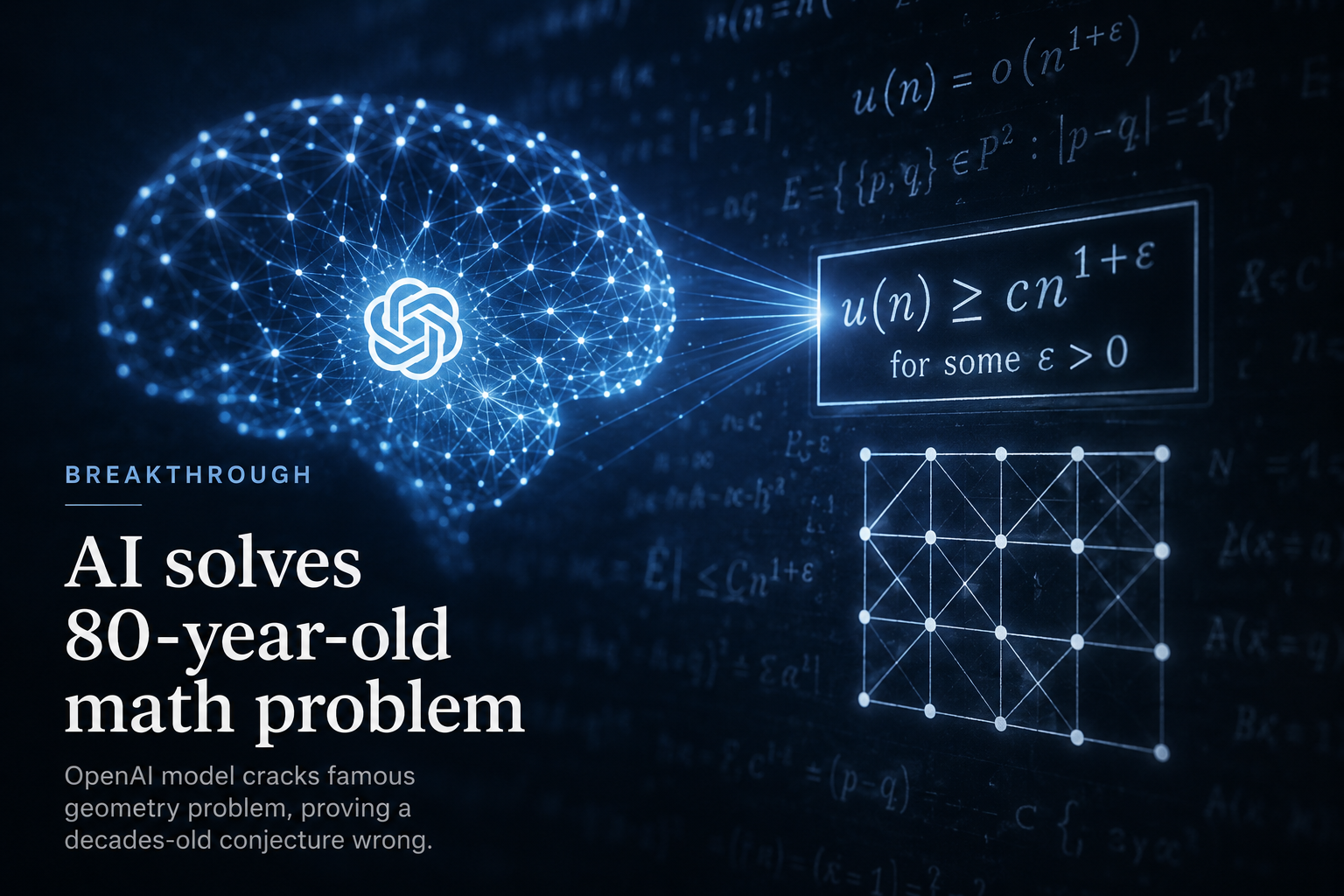
On Wednesday OpenAI published something many AI enthusiasts have been waiting for: a breakthrough on whether a model can invent something new when it is trained on data that already exists. An internal reasoning model solved a math problem Paul Erdős posed in 1946 that had stayed open for nearly 80 years.
The puzzle sounds simple: how many pairs of points in a plane can be exactly distance 1 apart? It came from Erdős' famous list of open problems. According to OpenAI, it is the best-known open question in combinatorial geometry, and for decades most researchers assumed the best answer was already within reach.
OpenAI ran its internal advanced model on a series of math problems. The model came back with a proof for this one, and independent mathematicians have since verified the result. That suggests we are reaching a turning point in AI: models are not just systematically recalling answers from training data, but finding new patterns and connections and inventing something new in the process.
The first people to read the model output at OpenAI were skeptical, the company says. It sounded too good to be true, and it took time to understand what the model was actually proposing. The problem is elementary geometry, but the proof drew on deep number theory. The path had so many branches along the way that humans could not realistically explore them all. The model could search more broadly and found a way through.
The criticism has long sounded the same: AI can only remember what it has learned. This result does not fit that story well. The solution was not sitting ready in a dataset, and it still held up when others went through it. That is why the news lands beyond the math crowd.
The bigger story is the turn in research. It is easy to picture scientists using AI to discover new things: find paths, test hypotheses, and move faster than a team could before. OpenAI itself says the result is a clear sign of where AI-assisted research can go, and a step up that may be looked back on as an important moment in the history of mathematics.
The story points to a new paradigm: researchers using AI models to make discoveries in medicine, biology, physics, and math. OpenAI itself expects an explosion of old puzzles and open problems suddenly getting answers.